

Sierra Leone: Journalists Equipped to Tackle Mental Health Stigma
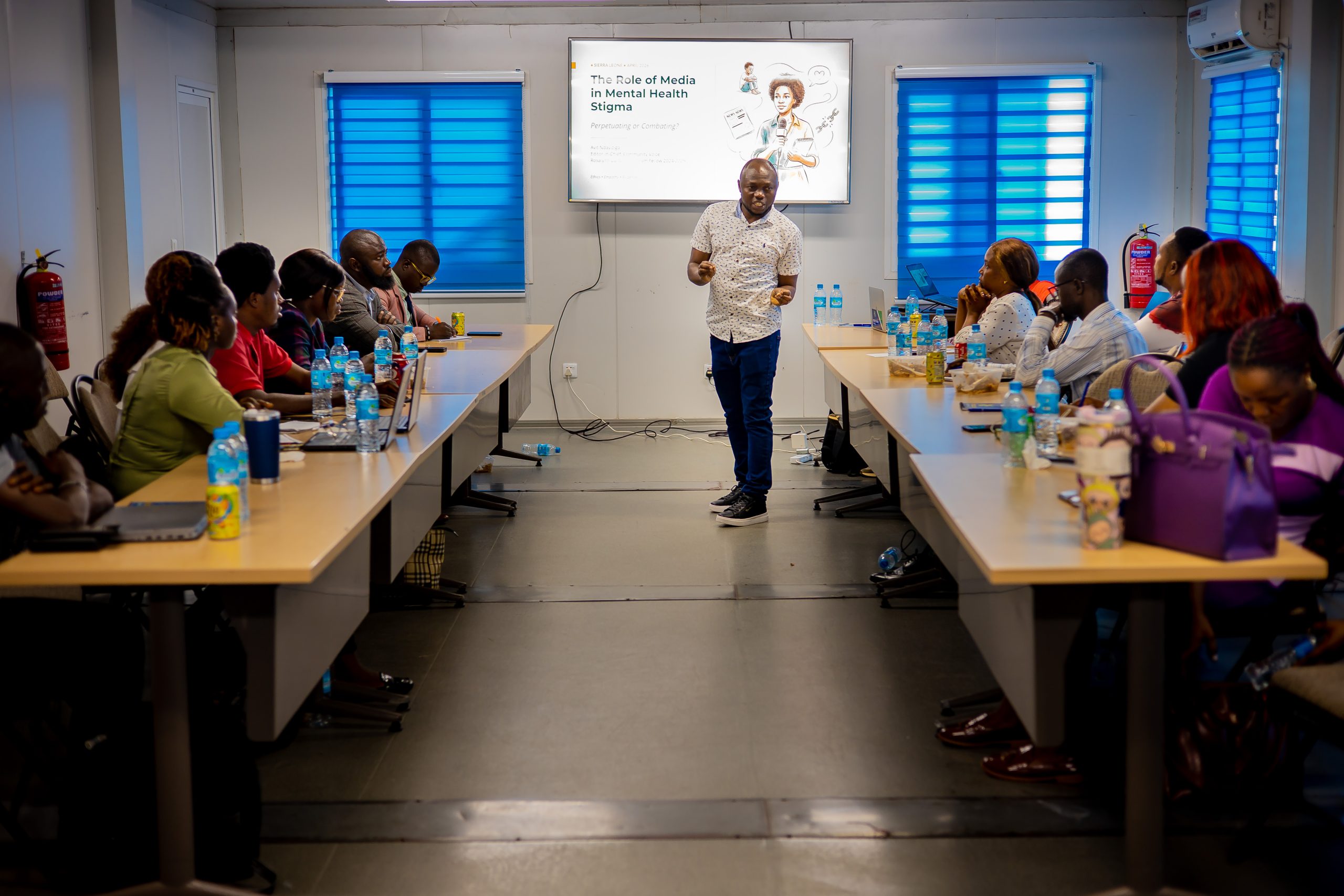
In Freetown, Sierra Leone, journalists were trained in responsible mental health reporting, an effort aimed at tackling stigma fueled, in part, by the media itself.
April 20-21, 2026, I participated as a facilitator in a two-day workshop on Responsible Mental Health Reporting for Media Professionals in Freetown, Sierra Leone.
It was organized by the Rosalynn Carter Journalism Fellowship (RCJF) based at Emory University and the Liberia Mental Health Reporters Network, in partnership with The Carter Center, the Mental Health Coalition of Sierra Leone, and the Ministry of Health, Non-Communicable Diseases and Mental Health Directorate.
During this workshop, I facilitated on the role of the media in perpetuating or Combating Mental Health Stigma.
In Sierra Leone, about 15% of the population lives with a mental disorder, yet the treatment gap is staggering at 98%, meaning nearly everyone who needs care goes untreated.
The country has only three psychiatrists serving a population of around 8 million and just one national psychiatric hospital. Substance use is also a growing concern, with 70% of patients at the Sierra Leone Psychiatric Teaching Hospital identified as Kush users in 2024. Additionally, 77.9% of all mental health admissions are among young people aged 14–35.
According to the World Health Organization, the Mosaic toolkit to end stigma and discrimination in mental health, nine out of 10 people living with a mental health condition say that the media have an important role to play in reducing stigma.
However, the toolkit highlights that the same media, both traditional media (e.g., newspapers, television, radio) and new media (e.g., social media), can play a role in perpetuating stigma.
They may use language that misrepresents or dehumanizes people with mental health conditions, reinforcing harmful and false stereotypes (such as linking mental health conditions with violence) that may be used to justify poor treatment.
Underreporting or turning a blind eye to mental health conditions is also another form of perpetuating stigma, as it leaves behind unheard voices of vulnerable communities.
In my presentation, I highlighted that for media professionals to maintain trust and play a crucial role in reducing stigma, they need the ability to tell the whole story with a human-centered, solution-oriented approach.

I emphasized that to achieve the above goal, they need the best sources, which are both reliable and inclusive. These include mental health professionals, the government agencies, the WHO, CDC, and consider incorporating the expertise and perspectives of peer support workers, people who share the experience of living with mental illness or substance use addiction.
However, for journalists, to drag and keep the audiences, listeners, readers, and watchers, they need to use the story arc of tension storytelling techniques. In a story arc, stories typically begin with a calm introduction, followed by a conflict-ridden middle that builds to a climactic peak, and end with a resolution.
The workshop concluded with the drafting of a Reporting Guide for Journalists on Mental, Neurological, and Substance Use Disorders. (MNS).
The reporting guide lays out six principles that are indispensable to every responsible MNS story. They apply to all beats, crime, health, politics, and others.
The six principles are: Person-First Language, use clinical and medical Terminology, never assign blame or imply choice, focus on recovery and agency, ask for Preferred terminology, and only mention diagnosis when relevant.
Journalists were also reminded to keep learning more about mental health, mental illness, substance use disorders, recovery, and stigma, as reporting on them is daunting, while they cannot report beyond their understanding of the subjects.