

Traders in Tug of War Over Burundi’s Digital Billing Machines
From Digital ID systems, Data protection and cybersecurity laws, AI strategies, and universal connectivity, Burundi has embarked on a bold digital journey to redefine governance, business, and daily life. However, insufficient and outdated digital public infrastructure, goods, and related challenges still impede progress, despite initiatives to overcome them.
This series takes you inside the country’s push toward ambitious digital transformation. Current initiatives, challenges, and expected outcomes.
This series has been produced under the Digital Public Infrastructure (DPI) Journalism Fellowship for Eastern Africa and Media Partnership with CIPESA.
Part 4
Part four delves into the challenges faced by taxpayers with the OBR’s billing machines introduced three years ago and the government’s response.
The billing machine heavy burden
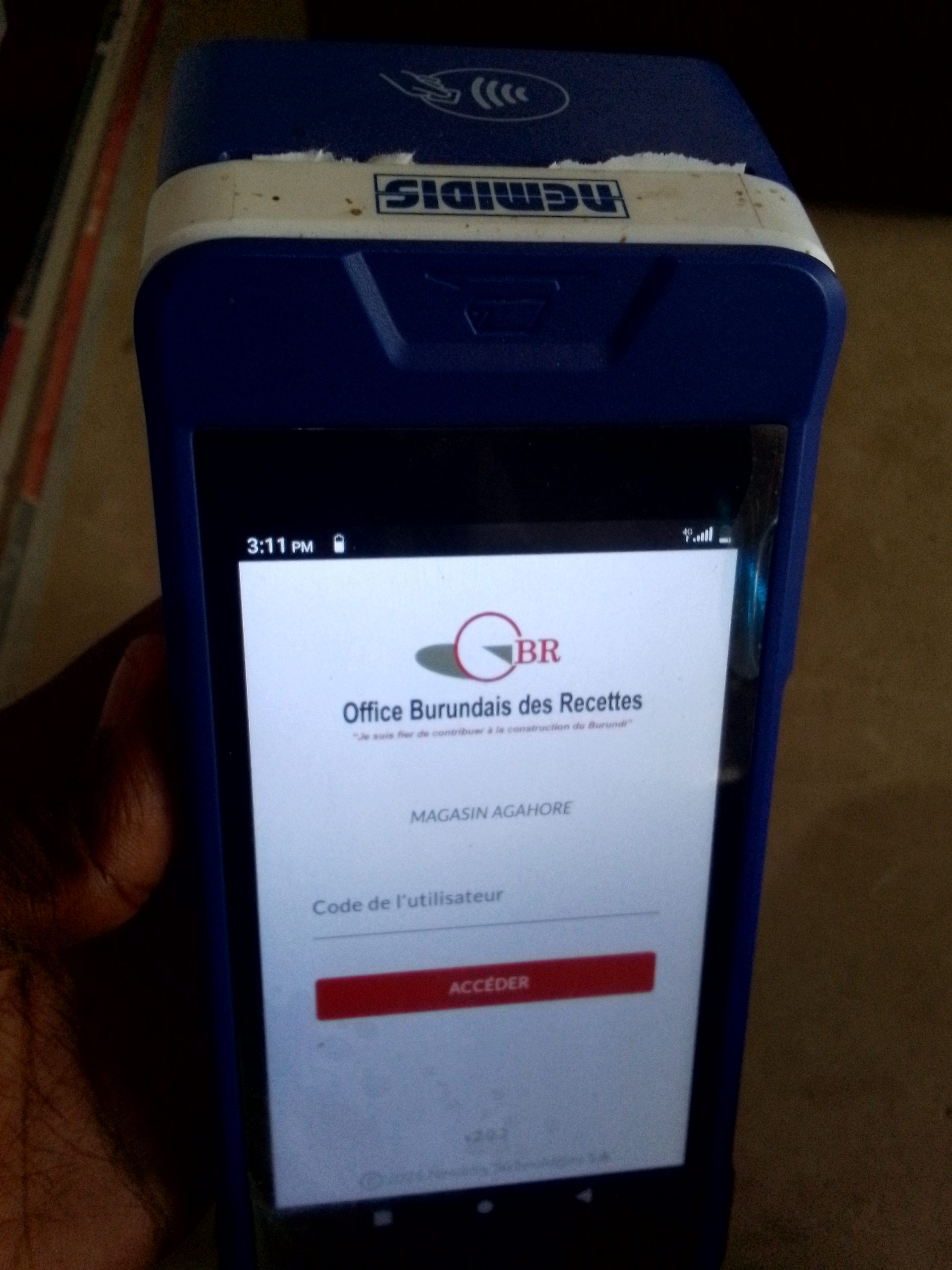
Aside from e-kori, OBR has been using another digital device called a “billing machine”. However, the device has sparked a tug-of-war among traders. Since the Office Burundais des Recettes (OBR) rolled out digital billing machines three years ago, officials have praised them as essential Digital Public Infrastructure and Goods (DPI) and (DPGs) to boost tax collection and increase transparency, in line with Burundi’s digitalization agenda.
However, both traders and activists argue that these digital goods place a heavy burden on their businesses.

Since these digital tools have become mandatory for traders with annual turnover exceeding 25 million Burundian francs, Judith Ndayisaba, a veteran trader of loinclothes with 14 years of experience at Ruvumera market, says she was not ready for them.
When we met her at Ruvumera market, just two kilometers away from Bujumbura’s city center, the day’s business was at its peak in the final hour before closing. Stalls overflow with second-hand clothes, food staples, spare parts, and other items.

Her stalls are not far from the market entrance. Judith Ndayisaba is issuing receipts to her customers via the digital device. So far, more than 13,000 devices are currently in use across Burundi. This number was announced during the celebration of Taxpayers’ Day on December 5, 2025, in Gitega, Burundi’s political city.
During this annual ceremony, the General Commissioner OBR, Mr. Emmanuel Mbonihankuye, urged Burundians to embrace digitalization to reach the country’s 2040-20260 vision.

“Let us embrace digitalization in our businesses and properly pay our taxes and duties. Thus, make Burundi an emerging country by 2040 and a developed country by 2060,” he urged.
Burden on Small Traders
Ndayisaba, like any other Burundian, supports the country’s 2040-20260 vision. However, she diverges from the OBR commissioner on the tax digitalization system. For her, the device has earned her frustration but enriched OBR. “I am now only working for the OBR,” she laments, referring to the Burundi Revenue Authority.
Ndayisaba explains that taxes have tripled. “For three months, we used to pay only fifteen thousand Burundian francs,” she recalls. “But now, once the billing machine prints out a sum of ten million, they tax us a hundred thousand. “After taxes, nothing is left for my family. I cannot meet my daily expenses,” she says.

Ndayisaba also points out the challenges she encounters. “Since I did not study, I had to find someone else to help me operate it. It doesn’t even use our mother tongue, Kirundi.”She said.
For Ndayisaba, the digital system serves the government’s welfare, but for small traders like her, it is a nightmare.
Faustin Ndikumana, an anticorruption activist and president of PARCEM (Words and Action for Awakening Consciences and Changing Mentalities), echoes these frustrations. For him, the machines enforce rigid fiscal rules but ignore local realities such as informal credit systems, the lifeblood of small-scale trade. “Without adaptation, traders are left with little income after taxes, unable to meet their daily expenses.”He warned.
Divided Opinions
Even though Ndayisaba is frustrated with digital devices, not all traders share the same views. A construction materials seller, whom we met at the same market, but kept anonymous, praises them for saving time and reducing disputes. “I no longer queue at OBR offices,” he explains. “Before, I had to count paper bills to calculate taxes. Now, after three months, I simply check the totals and pay via mobile systems.”
For him, the digital device reduces human error and strengthens trust between traders and tax authorities. Yet he admits flaws: “traders cannot cancel bills, power cuts stall transactions, and rigid pricing erodes bargaining power.”
OBR’s Defense
During Community Voice’s exclusive interview with Stany Ngendakumana, Director of Communication and Taxpayer Services at OBR, he addressed all the concerns and issues raised by both traders and activists. Even though he acknowledges them, he stresses that training programs and language integration are ongoing to reverse the situation. “We are working tirelessly with the Academy Rundi to integrate Kirundi into the system,” he says.

For this director, adding Kirundi is a step toward inclusivity, but electricity shortages and unreliable internet, hindering the device operations, fall outside the OBR mandate. He calls other service providers to cooperate. These include Regideso, the national provider of water and electricity, as well as other stakeholders and decision-makers.
In the meantime, the communication director warns against tax evasion, noting what the laws stipulate on non-digitally billed Products. “Products without recognized bills are seized, buyers fined 20 percent of the product’s value, and sellers fined 100 percent.” He cautioned.
Even though the OBR seeks to address these challenges, Ndikumana argues that the above-cited challenges show that the digital billing machines lack the interoperability, user-centered design, and inclusivity that characterise sustainable digital public goods.
For him, OBR needs to find digital solutions that promote the welfare of all, not just increase taxes while traders suffer losses.
Rising Revenues, Rising Tensions
During the fiscal year spanning July 2024 to June 2025, the authority recorded revenues of 2,432.6 billion Burundian francs, surpassing forecasts.
For OBR officials, the use of digital billing machines lays a strong foundation for a digital economy by strengthening transparency, combating fraud, and curbing tax evasion.
The General Commissioner of the Burundi Revenue Authority (OBR), Mr. Emmanuel Mbonihankuye, emphasized that the digital billing system has increased taxes despite delayed payments.
“Tax revenues are on the rise,” Mr. Mbonihankuye noted. “But we still see traders who disappear or postpone paying their dues. Sooner or later, they will be compelled to comply.”He warned.
Despite warnings from Mbonihankuye, Olivier Suguru, a lawmaker and the president of the Federal Chamber of Commerce and Industry of Burundi (CFCIB), argues that rigid tax calculations undermine business viability, already under pressure from foreign currency shortages. “Traders often turn to the black market for foreign currency, while the OBR demands taxes based on official rates set by the Central Bank. This mismatch leaves traders squeezed between market realities and state demands.”

The President of CFCIB adds that local taxation should also refer to regional laws and organizations to which Burundi is a member, and that Burundian traders obtain goods from them. At this point, Suguru mentioned the COMESA Treaty, which requires Member States to eliminate internal customs duties and harmonize tax policies, establish a common external tariff, prevent double taxation, and create mechanisms for refunds, compensation, and revenue safeguards. Taxes must not be used to distort trade or investment within the region.
Digitalization Against Corruption
The head of State, Evariste Ndayishimiye, during his meeting with media professionals, journalists, and influencers on December 1, 2025, at Ntare House Palace, said that digitalization strengthens transparency in fiscal systems and reduces opportunities for manipulation. However, he added that for the DPI and DPGS to truly serve citizens, they must be open-source, multilingual, and adaptable.
He turned to broader obstacles limiting traders’ adoption of digital tools, notably the persistent shortage of foreign currency. He emphasized that integrating digital strategies into the mining sector would not only boost revenue but also enhance foreign-exchange inflows.
Traders’ Hopes and Fears
For traders like Ndayisaba, the president’s assurances bring some relief. She hopes that stable currency and fair taxation will allow her to feed her family. But her daily reality remains a harsh digital billing machine that symbolizes both promise and hardship.
Faustin Ndikumana, president of PARCEM, dismissed the head of state’s assurances as ‘mere words of a politician.’ He argued that Burundi should draw lessons from its East African neighbors, citing Kenya’s inclusive digital payment system, M-Pesa, and Rwanda’s Irembo.gov platform, which allows citizens to apply for and download public documents online. ‘Unless Burundi embeds digital public infrastructure (DPI) and digital public goods (DPGs) that uphold openness, inclusivity, and adaptability,’ Ndikumana warned, ‘the country risks alienating small-scale traders who form the backbone of its informal economy.
Addressing the digital divide and fragmentation, Irakoze reminded that, through PAFEN, they are also working with the Ministry of Finance to introduce an integrated public financial management system and with the Ministry of Civil Service to implement a human resources, salaries, and payroll management system for civil servants.
“Finally, we plan to work with the Central Bank to establish a single Treasury account, thereby strengthening the backbone of public financial management.” Added Irakoze.
After this, part five will take us to the law, especially data protection and cybercrimes