




DPI and DPGs set to boost agricultural harvests in Burundi
From Digital ID systems, Data protection and cybersecurity laws, AI strategies, and universal connectivity, Burundi has embarked on a bold digital journey to redefine governance, business, and daily life. However, insufficient and outdated digital public infrastructure, goods, and related challenges still impede progress, despite initiatives to overcome them.
This series takes you inside the country’s push toward ambitious digital transformation. Current initiatives, challenges, and expected outcomes.
This series has been produced under the Digital Public Infrastructure (DPI) Journalism Fellowship for Eastern Africa and Media Partnership with CIPESA.
Part7
This part highlights how DPI and DPGs could serve as digital tools to boost agricultural yields in Burundi, despite persistent challenges such as high prices.
Digital goods in agricultural productivity
“I now harvest weekly,” says enthusiastically Juste Abel Ndikumasabo, a passionate modern farmer of passion fruit in Mwaro District, Gitega Province, in the central part of Burundi.

This passion fruit farmer praises modern technologies for increasing harvests and profitability. “I started farming using traditional methods, like other farmers. But it was stressful because I had to reap once every six months. But since I started using drip irrigation, I now reap weekly and most importantly, even in the dry season.” He noted.

Ndikumasabo adds that, beyond drop-by-drop irrigation, he usually relies on mobile applications to treat passion fruit plants when diseases attack. “I take a photo of a sick plant and upload it to ChatGPT, and it gives me possible diseases and medications. I then buy them at the Agrovet shop or Agrochemical shop and apply them accordingly.”He emphasized.
For him, the digital solution has made the task easier. Before, I had to call the agronomist to come and take samples. And wait for the examination results, which would take months and months, while my crops would gradually be damaged.” He emphasized.
Undoubtedly, Ndikumasabo is one of the 85 percent of Burundians who rely on agriculture for their livelihood, according to the “General Census of Population, Housing, Agriculture and Livestock in Burundi, 2024 Edition (RGPHAE, 2024). And specifically among only 6% who are applying modern and digital technologies in farming.
Despite a large number of Burundians being farmers, Burundi remains among the countries with acute hunger and malnutrition. However, the government has initiatives to digitalize and modernize the agricultural sector and boost production to later eliminate hunger.
Burundi Accelerates Agricultural Digitalization
“We are digitalizing several services from office to field to boost both production and harvest,” says Eric Niyonkuru, Director of Information and Communication Technologies at the Ministry of Environment, Agriculture and Livestock (Mineagrie).

“All of these digitalization efforts align with the President’s slogan, ‘Feed every mouth,’ and the country’s Vision. Added Niyonkuru.
This director notes that the Mineagrie, through SETIC, is currently developing a digital records management application and another, dedicated to seed monitoring, with support from the FAO. Studies are also underway to develop applications for fertilizer tracking and soil evaluation.
For him, digitalization must go beyond offices. “For now, mobile agricultural applications, offering weather forecasts, farm advice, and crop monitoring, are emerging.”
He also cites that the Mineagrie plans to use connected sensors to measure soil moisture, temperature, and fertility levels, enabling more precise management of inputs, leading to higher yields, reduced production costs, and better harvest forecasting.
Digital Marketing and e-commerce are also being implemented. “Sales platforms are coming to directly connect farmers and buyers, which promotes price transparency,” the director emphasizes.
Youth promotes digital dynamism
Niyonkuru highlights that young people in Burundi have enthusiastically responded to the head of state’s call and are actively contributing to the digital agricultural dynamic.
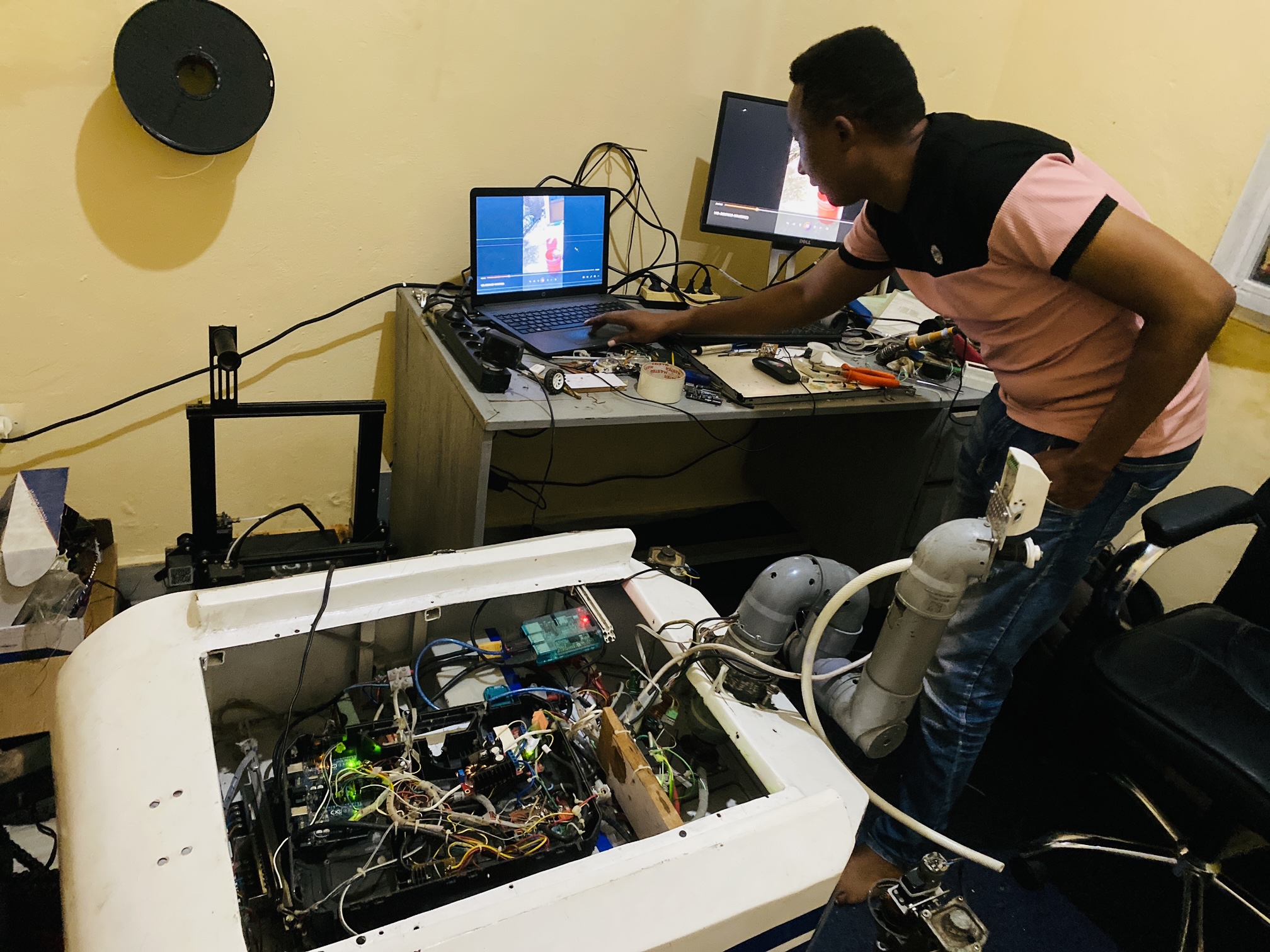
He gives the example of Students at the University of Ngozi who have developed an application to detect crop diseases, while another young innovator, called Armel Akimana, is developing a robot designed for crop weeding.
For Niyonkuru, the benefits are clear: “faster interventions, greater precision through drones, GPS, and sensors, optimized use of inputs, and improved decision-making which leads to increased harvests.”
In the same framework to realize the president’s slogan of feeding every month, he reminded that they have been subsidizing chemical fertilizers, allocating 21 percent of their total budget to the program, which covers 45 percent of each farmer’s fertilizer costs.
However, the absence of digital tracking tools has led to mismanagement, leaving farmers empty-handed and reducing their harvests, while it was sold on the black market at high prices.
Digital solution to replace human resources
“As a farmer, I have realized that the rural exodus has reduced the pool of human resources.”Says Armel Akimana, a software engineer currently developing a crop-weeding robot to meet his farming needs.

Akimana adds that the rural exodus has negatively affected farming activities. “The cost has skyrocketed.”
The farmer notes that crop weeding requires precision and is time-sensitive. “When done by hand and a hoe, it lacks precision and is time-consuming, which decreases the harvest. The use of pesticides by humans is harmful to their health.” This means that the use of robots is important in various ways. As we move toward agribusiness, human labor cannot produce enough food for both the market and household consumption.
Akimana emphasizes that it is now mandatory to use modern digital technologies in agriculture. “There is no workforce anymore. Who will work on 5 hectares, 10 hectares, or more? And who will then create the fields? Who will irrigate? So, we are obliged. It is an obligation to use new technologies.”He urged.
Philippe Bizimana, a farmer we met in Mwaro District, Gitega Province, near the passion fruit plantations of Juste Abel Ndikumasabo, regrets that using traditional farming methods leads to lower yields, but modern technologies require a large amount of money he cannot afford.

“I asked for the requirements to start farming in modern ways, but I found out it is very expensive. For instance, they said they use a method called grafting, which resists crop diseases and is highly profitable. Unfortunately, I cannot afford the cost they quoted.”Regretted Bizimana.
On the other hand, Dr. Therence Ndayisaba, a lecturer in Data Science, Automation, and Software Engineering at the University of Burundi, notes that traditional agricultural practices persist despite a few digital initiatives in seeds, fertilizers, and disease-tracking tools.

“I think we still have a lot to do for the automation and digitalization of the agricultural sector, particularly in monitoring and support.”
The doctor emphasizes that Burundi remains behind neighboring countries such as Tanzania, Rwanda, and Kenya, and even more so developed countries, but that this should serve as a wake-up call to accelerate efforts.
He cites examples such as Kenya, Israel, and other countries that have succeeded in digitizing and automating agriculture even on small plots.
He emphasizes the major obstacles: energy shortages, power cuts, slow Internet, difficulty accessing equipment, and financing. He highlights local initiatives, such as chemical fertilizer production in Burundi and the efforts of young innovators, for example, Armel Akimana, in agricultural robotics.
According to him, robotics would reduce human errors, increase productivity, and modernize agriculture. He calls for a clear national policy, the organization of general assemblies, and support for young innovators through tax exemptions, coaching, and financing.
Finally, he encourages young people to persevere despite challenges, reminding them that innovation and entrepreneurship are always difficult at the beginning but possible with determination and support.”
Both Akimana and Bizimana call for financial and capacity-building support to fully integrate digital technologies into agriculture, boost production and harvests, and, later, eliminate hunger and malnutrition in their families and across the country.
The next part will dig into E-commerce platforms in Burundi.