

Capital Flight Deepens Africa’s Debt Crisis and Poverty, Economists Warn
By Avit Ndayiziga
The ongoing capital flight from African nations has worsened external debt burdens, destabilizing the continent’s fragile economies and driving millions deeper into poverty. Professor Léonce Ndikumana calls for strategic reforms and investment incentives to stabilize these economies and foster sustainable development.

The distinguished Professor of Economics at the University of Massachusetts highlighted this during a crucial yet underrecognized debate on capital flight in Africa. Hosted by the Bank of the Republic of Burundi (BRB) at the Donatus Conference Center on August 20, 2024, this debate brought attention to a pressing issue with far-reaching consequences.
The debate comes after Professor Léonce Ndikumana and James K. Boyce from the Political Economy Research Institute (PERI), University of Massachusetts-Amherst in the USA, published a research paper entitled Capital Flight from Africa: The Takers and the Enablers.
Addressing top officials of Burundi, including President Evariste Ndayishimiye, ministers, and executives, Professor Ndikumana revealed the staggering impact of capital flight, showing how Africa has lost trillions, severely straining its economy.
This capital drain has trapped Africa in poverty, escalating debt, disease, conflict, poor leadership, and corruption.
Capital Flight’s Impact on Investment
“Africa is now facing slowdowns in international trade and domestic economic activity that deepen the financing gaps. The financing difficulties are exacerbated by capital flight. The erosion of the tax base by capital flight undermines private and public investment, further exacerbating gaps in infrastructure and public services such as education and health and holding back the continent’s progress towards poverty reduction,” Ndikumana stated.
Alarming Losses from Misinvoicing
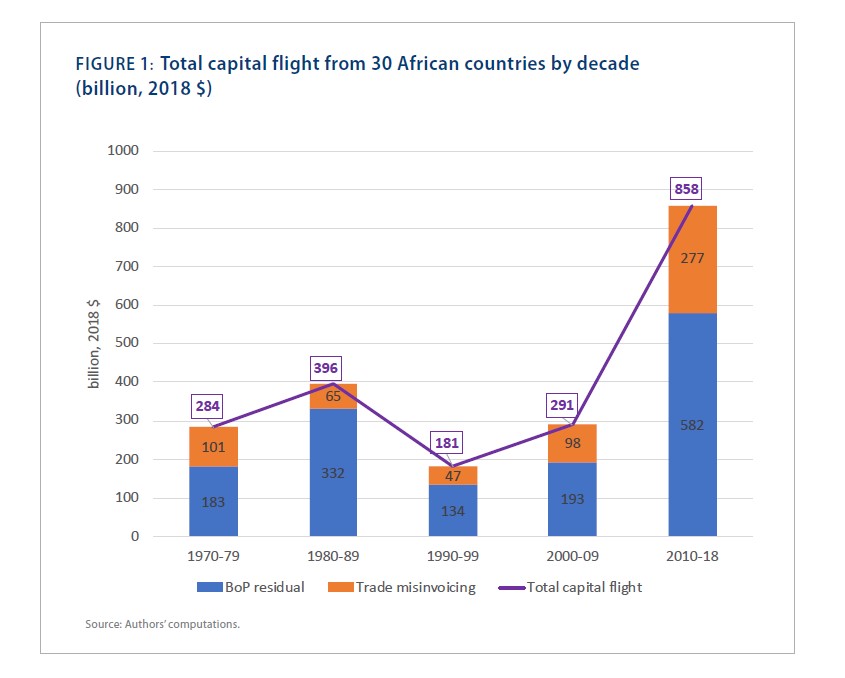
Misinvoicing of exports and imports contributed $588 billion to the total capital flight.

In his presentation, Professor Ndikumana explained, “within 49 years, 30 African countries lost a combined $2 trillion (in 2018 dollars) through capital flight. Net misinvoicing of exports and imports contributed $588 billion to total capital flight. The amount far exceeds the $720 billion of external debt this group of countries owed as of 2018, making them a ‘net creditor’ to the rest of the world.”
Who are the capital takers and enablers?
The research, covering 30 African countries, including Burundi, showed significant capital losses. Over the same period, Burundi alone lost U.S.$5.7 billion—far exceeding its external debt of about U.S.$1.8 billion.
Dieudonne Dukundane, Burundi’s Minister of Infrastructure, Equipment, and Social Housing, asked the question, “Who are the capital takers and enablers?” Upon seeing the poster confirming my attendance, my friend humorously commented, “Well, I hope you’ll come back with a detailed list of takers and enablers.” Laughter filled the room as he added, “That’s the expected outcome on every Burundian’s mind.”

The minister continued, “When calculating these figures, it is evident that the country loses a staggering U.S. $200 million annually. This substantial sum could have been used to construct a railway without incurring debts.”
“If 60% of U.S.$5.7 billion have flown through underbilling and overbilling, importers and exporters are known. We can track those who enabled and took the $3 billion in capital flight,” he underlined.
However, Dukundane noted that some financial losses result from contracts bound by conditions beyond their control when receiving development aid. He lamented that “60% of funding eventually flows back to the donors” and questioned how the country might escape this cycle.
$17 Million Loss in Coffee Sector Revealed
Echoing these concerns, President Ndayishimiye spotlighted Burundi’s coffee sector, where a loss of $17 million from 2016 to 2019 emerged from discrepancies between the volumes sold by the Office for the Development of Coffee in Burundi (ODECA) and amounts purchased by the International Coffee Organization (ICO).

Burundi’s Fuel Crisis Linked to Capital Flight
Ahead of the debate, Burundi’s president expressed deep concern over the nation’s three-year fuel shortage, attributing the crisis to capital flight and poor management by the sector’s overseers.
“A recent investigation has uncovered that 36% of the budget allocated for fuel purchases in Burundi is being diverted each year through organized schemes involving brokers. This underscores the significant obstacles hindering the nation’s progress,” the president stated. He urged Burundians not to fear addressing capital flight, emphasizing that it could be resolved gradually through collaboration and commitment to national development.
Despite the president’s efforts to expose administrative mismanagement, activists and opposition politicians have mocked him, questioning how a leader can voice frustration like an ordinary citizen while wielding authority to hold officials accountable.
Global Strategies to Combat Capital Flight: Insights from Ndikumana
While the scale of capital flight is daunting, Professor Ndikumana highlighted a range of potential solutions. He emphasized that “the international community must recognize capital flight as a global phenomenon, including its impact on both host and destination countries.” He urged the creation of a global framework incorporating African nations and institutions at bilateral and multilateral levels.
Within Africa, he called for strengthening institutions and legal systems focused on transparency and monitoring to obstruct capital flight’s domestic enablers. Transparent destination countries would combat corporate corruption, tax evasion, and enforce anti-money laundering rules.
Globally, inclusive international bodies like the United Nations (UN) should support regional efforts to combat capital flight, ensuring African countries have a voice in international development policymaking. He cited the UN Economic Commission’s High-Level Panel on Illicit Financial Flows from Africa as a valuable example, stressing the importance of sustaining this panel to promote awareness and action against capital flight at the highest policy levels in Africa and beyond.